Time now · 4 min read
Why the Moon needs its own time standard
NASA's work on coordinated lunar time explains why future missions cannot simply use Earth clocks unchanged.
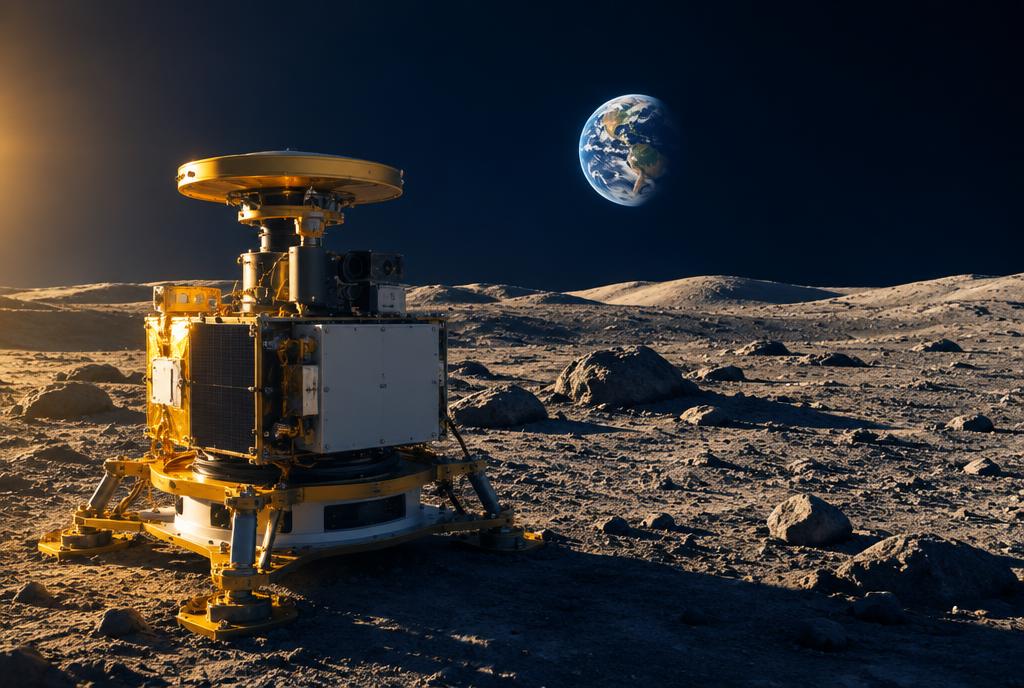
As plans for sustained lunar exploration advance, keeping time on the Moon has become a practical engineering question. A rover, spacecraft and ground station need to agree not just on a date, but on exactly when a measurement was made.
Why Earth time is not enough
Atomic clocks on the lunar surface do not run at precisely the same rate as clocks on Earth. Gravity and motion affect their rates, a measurable consequence of relativity. NASA estimates a lunar clock gains roughly 58.7 microseconds per Earth day relative to an Earth clock. That sounds negligible until timing signals are used to calculate a spacecraft's position.
Navigation turns tiny differences in signal travel time into distances. Missions can compensate when everyone uses compatible definitions, but independent networks without common timing rules risk disagreeing about what an observation means. The point is not that people on the Moon will need a new wristwatch face; precision systems need a shared reference.
The work underway
NASA has been tasked with developing a strategy for Coordinated Lunar Time, often abbreviated LTC, alongside international and commercial partners. Its published explanation emphasizes interoperability for future lunar operations. A strategy is not the same thing as a fully operational lunar clock network: the details of how it will be realized and distributed matter.
On Earth, UTC works because a network of laboratories and standards bodies coordinates reference clocks. A lunar equivalent must also connect the Moon's local reference to terrestrial UTC, so a timestamp can be interpreted across mission control, orbiters and the surface. Different missions will still have local schedules, but their instruments need comparable instants.
What to watch next
The standardization process and future lunar navigation systems are still developing. Check the latest NASA and metrology updates before treating a proposed specification as final. The underlying lesson applies beyond space: a clock reading becomes truly useful when its reference, location and method of synchronization are known.
For everyday planning, you do not need to calculate relativistic corrections. UTC and a named local time zone remain the practical tools for coordinating a launch webcast or an international team watching one.
Sources & further reading
These sources provide the underlying standards or research. This guide is educational and is not medical advice.